Books / Lived experience, memoir & fiction
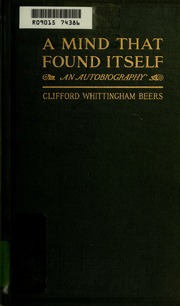
A Mind That Found Itself: An Autobiography
Clifford Whittingham Beers’s 1908 memoir recounts his experience in psychiatric institutions in Connecticut and the abuse he witnessed. It became influential in his campaign for mental health reform in the United States.
Book details
Author of listed edition: Clifford Whittingham Beers
Edition: 1908 edition
Publisher: Longmans, Green, and Co.
Edition year: 1908
Language and origin: English (United States)
Form and genre: Memoir, Fiction & Lived Experience
Level: Introductory
Historical era: Pre-1919 · Asylum Reform & Early Psychoanalysis
Covers: Beers’s account of institutional care and mistreatment in Connecticut; His experience of confinement and mechanical restraint; A patient’s perspective on mental health care and reform
APA 7th reference: Beers, C. W. (1908). A mind that found itself: An autobiography. Longmans, Green, and Co.
What it is & historical context
After a suicide attempt in 1900, Beers was admitted to psychiatric institutions in Connecticut. A historical account describes stays at Stamford Hall, the Hartford Retreat and the Connecticut State Hospital at Middletown between 1900 and 1903, followed by a further admission in 1904. His memoir was published in 1908.
Core clinical themes & arguments
Beers describes his experiences of mental illness, confinement and mistreatment. In an excerpt from the 1908 book, he recounts being confined and restrained during a three-week period in 1902. The account offers a personal perspective on institutional conditions; it does not by itself establish the effects of particular treatments.
Clinical practice, reception & legacy
The book helped draw attention to institutional treatment and became part of Beers’s advocacy for reform. Yale’s archive records that he founded the Connecticut Society for Mental Hygiene in 1908 and the National Committee for Mental Hygiene in 1909. A later historical article traces his role in mental health reform.
Reader level & educational scope
The memoir is an accessible historical account for readers interested in lived experience and the history of mental health care. Its descriptions of abuse and restraint may be distressing. It is one person’s account in a particular historical context and is not a guide to current clinical practice.
Paired academic and clinical scholarship
Paired work: From a Patient's Perspective: Clifford Whittingham Beers' Work to Reform Mental Health Services (Manon Parry, 2010)
Reference: Parry, M. (2010). From a patient's perspective: Clifford Whittingham Beers' work to reform mental health services. American Journal of Public Health, 100(12), 2356–2357. https://doi.org/10.2105/AJPH.2010.191411
A short historical account of Beers’s experiences and his role in mental health reform.
Source-mapped claims and evidence notes
Claim 1: Beers described confinement, restraint and abuse during his institutionalisation. (This excerpt is Beers’s first-person account, not a controlled study of treatment outcomes.) [Source 1: Beers, C. W. (1908). A mind that found itself: An autobiography. Longmans, Green, and Co. Excerpt reprinted in American Journal of Public Health, 100(12), 2354–2356 (2010).]
Claim 2: Beers founded the Connecticut Society for Mental Hygiene in 1908 and the National Committee for Mental Hygiene in 1909. (Yale’s archival guide dates the two organisations separately; the later event cannot be documented in the original 1908 edition.) [Source 3: Yale University Library. Clifford Whittingham Beers papers (MS 612), finding aid.]
Sources and inspection notes
Supports: Excerpt from the 1908 edition describing confinement and restraint; publication details.
Supports: Historical context for Beers’s hospital admissions and reform work.
Yale University Library. Clifford Whittingham Beers papers (MS 612), finding aid.
Supports: Dates of the Connecticut Society and National Committee for Mental Hygiene.