Books / Psychodynamic & attachment
The Interpretation of Dreams
By Sigmund Freud. His foundational treatise (published late 1899, postdated 1900) introducing the topographic model of the mind, manifest and latent dream content, and the dream-work.
Book details
Author of listed edition: Sigmund Freud
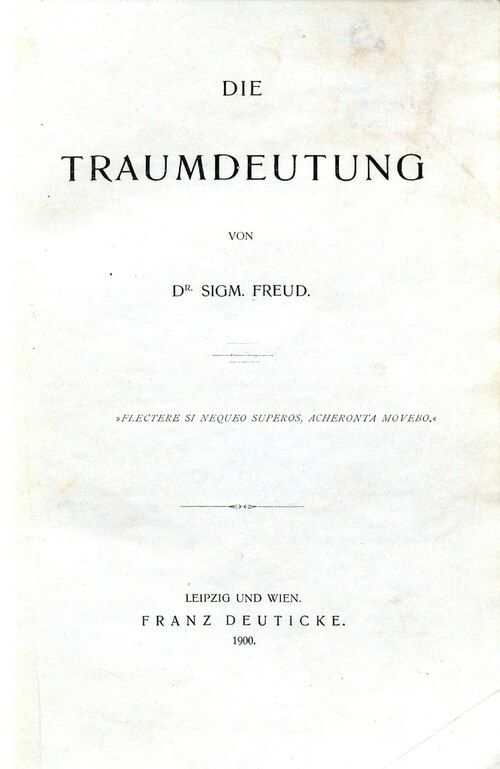
Edition: First German edition printed November 1899 and title-page dated 1900 by Franz Deuticke (Leipzig and Vienna)
Publisher: Franz Deuticke (Leipzig and Vienna)
Edition year: 1900
First published: 1899
Original title: Die Traumdeutung
Language and origin: German (Austria)
Form and genre: Clinical & Theoretical Monograph
Level: Advanced
Historical era: Pre-1919 · Asylum Reform & Early Psychoanalysis
Covers: Manifest and latent dream content, wish-fulfilment theory, dream-work mechanisms (condensation, displacement, symbolisation) and the topographic model of unconscious, preconscious and conscious systems
APA 7th reference: Freud, S. (1900). Die Traumdeutung [The interpretation of dreams]. Franz Deuticke. (Published November 1899).
What it is & historical context
The Interpretation of Dreams (German original: Die Traumdeutung) is Sigmund Freud’s foundational treatise on psychoanalytic theory and dream analysis. It was printed in November 1899 by Franz Deuticke in Leipzig and Vienna with 1900 on the title page, and revised by Freud across eight lifetime German editions.
Beyond dream interpretation itself, the book established free association and the search for latent symbolic meaning behind manifest speech as central methods of psychoanalytic psychotherapy.
Core clinical themes & arguments
Freud reviews earlier scientific literature on dreams, illustrates his method of free association using his own dreams (beginning with the specimen dream of "Irma’s injection") and patients’ accounts, and argues that dreams represent disguised fulfilments of repressed wishes. He formulates the "dream-work" processes of condensation, displacement, considerations of representability and secondary revision, and in the famous seventh chapter sets out the topographic model of the mind (Unconscious, Preconscious, Conscious) and primary versus secondary process thinking. This entry draws on verified archival and museum records.
Questions for critical reading
How does Freud’s method of asking a dreamer for personal associations to each dream fragment differ from fixed "dream dictionary" decoding? How has modern sleep and REM neuroscience challenged or reframed Freud’s wish-fulfilment hypothesis?
Who it may suit
Students and practitioners of psychoanalysis and psychodynamic therapy, historians of psychology and readers studying the origins of depth psychology.
Scope & clinical limits
This is a historical theoretical text from 1899/1900 based largely on Freud’s self-analysis and unblinded clinical interpretations. Its claims about universal wish-fulfilment and Oedipal symbolism are interpretive models, not established empirical facts.
Paired academic and clinical scholarship
Paired work: Dreaming and REM Sleep Are Controlled by Different Brain Mechanisms (Mark Solms, 2000)
Reference: Solms, M. (2000). Dreaming and REM sleep are controlled by different brain mechanisms. Behavioral and Brain Sciences, 23(6), 843–850.
Solms reviewed neuropsychological, radiological and pharmacological evidence and proposed that dreaming and REM sleep are dissociable states involving different brain mechanisms. The abstract does not establish a single cause of every dream.
Source-mapped claims and evidence notes
Claim 1: Released in November 1899 with the year 1900 printed on the Franz Deuticke (Leipzig and Vienna) title page. (The reprint catalogue dates delivery of the original edition to November 1899; the Library of Congress identifies its 1900 imprint and 1899 publication.) [Source 5: Freud, S. Die Traumdeutung: Reprint of the first edition. Google Books catalogue.]
Claim 2: Distinguishes manifest dream imagery from latent dream thoughts and describes condensation, displacement and secondary revision, culminating in Chapter VII’s topographic model of the psychic apparatus. (The Freud Museum describes manifest and latent content and dream distortion as parts of Freud’s model.) [Source 3: Freud Museum London. (2024). The Interpretation of Dreams: Dream distortion and the dream-work.]
Sources and inspection notes
Library of Congress. Die Traumdeutung: digitised edition.
Supports: Digitised edition and catalogue record identify the title, Deuticke imprint, 1900 title-page date and 1899 publication.
Library of Congress. Sigmund Freud: Conflict and culture, The Individual: Theory.
Supports: Exhibition describes Freud’s wish-fulfilment theory and the 1900 edition.
Freud Museum London. (2024). The Interpretation of Dreams: Dream distortion and the dream-work.
Supports: Educational summary of manifest and latent content, condensation and displacement.
Supports: Abstract presents Solms’s account of evidence that dreaming and REM sleep are dissociable; it does not prove a single universal mechanism.
Freud, S. Die Traumdeutung: Reprint of the first edition. Google Books catalogue.
Supports: Catalogue for a reprint dates delivery of the original edition to November 1899 despite its 1900 title page.